And, Perhaps, to Bloom

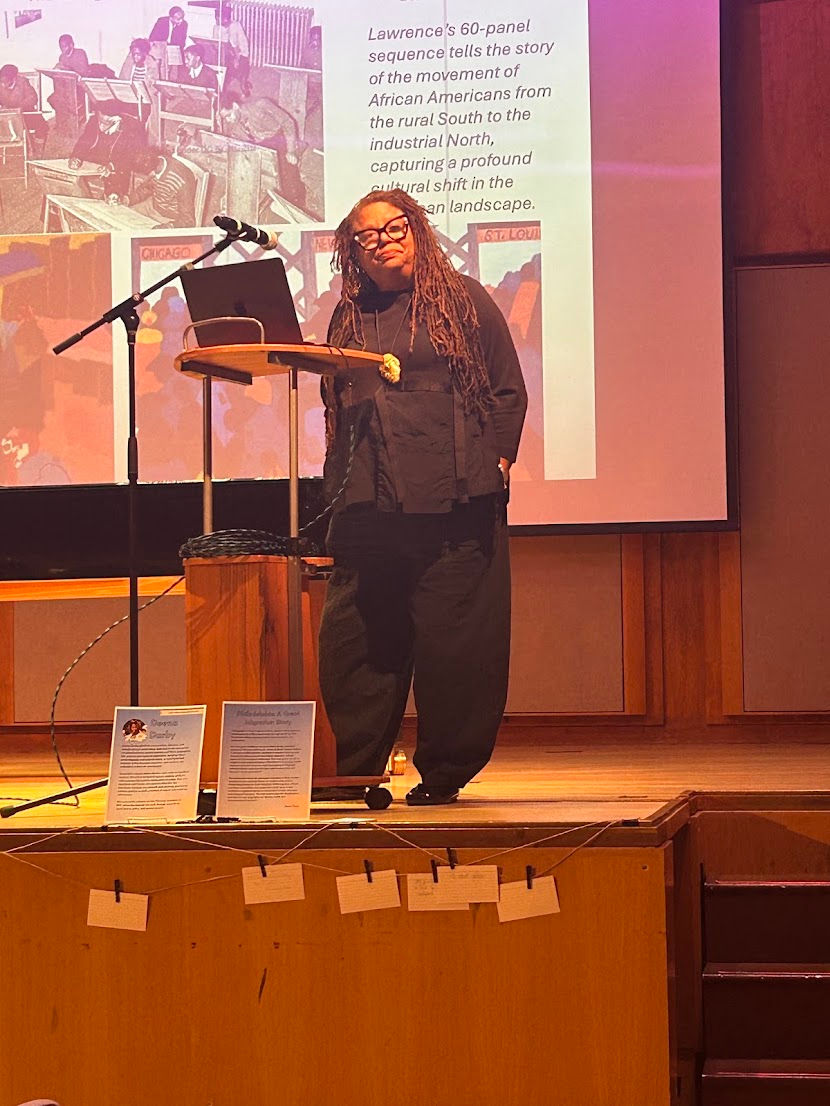
Artist, educator, historian, and speaker L’Merchie Frazier of the Museum of African American History guided the audience through a powerful exploration of migration, memory, creativity, and survival. Through her presentation, she wove together the artistic legacies of Augusta Savage and Jacob Lawrence, offering a profound and compelling account of the Great Migration through the lens of art, history, and lived experience.
Stepping into the exhibition, I found myself thinking about Augusta Savage—not simply as one of America's greatest sculptors, but as a woman who mastered the art of navigating spaces that were never designed for her. She educated herself, created opportunities where none existed, and ultimately established the Savage Studio. There, she cultivated talent and possibility, proving that art could become both an education and an act of liberation.
Among the many artists whose lives she influenced was Jacob Lawrence. Her belief in nurturing young Black artists helped shape one of the most important visual storytellers of the twentieth century. Lawrence would later create The Migration Series, sixty remarkable panels chronicling the journey of Black Americans leaving the rural South in search of opportunity in the industrial North.
As I stood before Lawrence's work, I wondered: What would have happened had he never discovered painting? Would these stories have remained untold? Art became more than a profession for Lawrence; it became a means of survival and a language through which history could finally speak.
Each panel carries the weight of movement—families leaving everything they have known, carrying little more than suitcases, bundles, and hope. Lawrence transforms migration into something larger than geography. His paintings become visual narratives of courage, sacrifice, uncertainty, and faith. They capture one of the most significant cultural shifts in American history while giving voice to people whose stories were too often omitted from the nation's historical record.
His work echoes the vision of W.E.B. Du Bois, whose lifelong mission was to make visible what America had chosen not to see: the brilliance, resilience, and contributions of Black people. Lawrence accomplishes this not through speeches or essays, but through color, shape, rhythm, and movement.
The exhibition also recalls the creative energy of the Harlem Renaissance, when artists, writers, musicians, and intellectuals gathered nightly to exchange ideas. The voices of Langston Hughes and Zora Neale Hurston seem to linger in these galleries. One can almost hear conversations about identity, justice, and possibility echoing between the paintings.
Lawrence once reflected on hearing familiar rhythms while walking the streets of Harlem. That memory speaks to the enduring power of culture. No matter how far people travel, they carry with them sounds, traditions, memories, and spirit. In Lawrence's paintings, the suitcases symbolize far more than clothing. They hold dreams, family histories, faith, and determination.
His images remind us that migration did not end upon arrival. Families found work mopping floors, laboring in factories, and doing whatever was necessary to survive. They built churches, beauty shops, neighborhood businesses, and community organizations that became anchors in unfamiliar cities. These spaces offered dignity, belonging, and hope.
The music traveled as well. Duke Ellington once remarked, "I don't think jazz; I think African music." Black Americans carried their musical traditions northward, and eventually across oceans. Jazz became another form of migration, transporting culture wherever Black people settled. Lawrence's paintings possess that same rhythm. They move with the syncopation of trains, footsteps, and generations searching for a better future.

Yet this exhibition reaches beyond the Black experience alone. Contemporary artist Ngoc Tran Vu explores migration through the stories of Vietnamese refugees who fled their homeland after the fall of Saigon. Referencing Indochina and the Refugee Act of 1975, she asks viewers to consider what people carry when they leave everything behind. Water becomes both barrier and bridge—a reminder that home is not always a place, but sometimes a memory.
Her work quietly asks questions that linger long after leaving the gallery. What would you carry if you had only moments to leave? Which objects would preserve your identity? What memories would sustain you when the destination remained unknown?
Those questions feel especially urgent today.
Lawrence's images of travelers holding worn suitcases continue to resonate across generations because they speak to a universal human experience. Migration is more than movement across borders; it is movement through hope, loss, memory, and survival! It is the determination to bloom in unfamiliar soil while carrying the essence of where one began.
Leaving the exhibition, I realized that Augusta Savage's greatest legacy extends far beyond the sculptures she created. It lives in the artists she mentored, the stories they preserved, and the generations they continue to inspire. Through Savage's vision, Jacob Lawrence gave history a face. Through Lawrence's paintings, migration became memory. And through the work of artists like Ngoc Tran Vu, we are reminded that the journey of displacement, resilience, and renewal belongs not to one people alone, but to humanity itself!

Comments